

AI SEO and Foundational SEO: What Smart Optimizers Are Doing in the New Year

If you’ve been tracking with your reporting, you may notice that website traffic is dropping. It might be more evident for brands that have consistently seen a large volume of traffic over the years. And there are enough studies out there to explain precisely why that is.
In 2024, nearly 60% of Google searches ended without a click. Users still search, but a large majority get their answers directly on the results page through Google’s AI summaries long before anyone reaches a website.
When AI Overviews (AIO) appear, the impact is immediate. Organic click-through rates drop by roughly 61%. Paid click-through rates fall by about 68% compared to earlier in the year.
Visibility, the core focus of SEO, on its own, no longer guarantees traffic.
Even when your content does the heavy lifting behind the scenes, attribution often disappears.
For some teams, this raises a question about the value of their SEO efforts. They read these numbers and assume traditional SEO no longer matters. Others rush to label everything “AI SEO,” treating it like a replacement for what they’ve always known.
Neither view holds up in practice.
SEO fundamentals still decide whether your content gets crawled, indexed, understood, and trusted. What has changed is how that content gets surfaced, and how users engage with it. Foundational SEO gets you into the system. AI SEO determines whether you get selected, cited, and shown.
Intelligent optimizers are not choosing between the two. They are rethinking their SEO strategy, tightening up the basics, and repurposing content in ways that work for both users and AI-driven search results.
That balance now defines effective SEO.
What SEO Still Does Well
Traditional, or as I prefer to call it, Foundational SEO, is not optional.
SEO is still the price of entry. If your site is not crawlable, not clearly structured, and not technically sound, you won’t stand a chance with AI.
AI search features do not bypass the index. They pull from it. Clean site architecture, logical internal linking, and accessible pages still decide whether your content even enters the conversation.
SEO continues to align your content with known ranking signals.
Keyword relevance, page speed, backlinks, and technical SEO still matter because they help improve online performance and help search engines understand what your content is about and when it should appear.
Google has been transparent on this point, with John Muller stating, “Having a website is the basis for being visible in all of these systems (AI, LLMs, chatbots, etc).
The fundamentals have not changed. Traditional SEO keeps content grounded in real search intent.
At its best, SEO was never about chasing keywords. It was about answering questions clearly and usefully. And while we have instilled this practice for 15 years, answering questions has become even more applicable as answer engines aim to satisfy user intent. Web pages that solve real problems, explain concepts clearly, or guide user decisions continue to perform better than pages built solely to meet algorithmic requirements.
AI-driven search features rely on the same quality signals as traditional results. If your content lacks clarity, depth, or trustworthiness, it will not rank or be referenced. If your pages are not crawlable, they won’t receive citations.
Weak SEO fundamentals limit AI visibility.
So on one hand, SEO no longer guarantees traffic. On the other hand, no SEO will limit or completely impact AI visibility.
3 Fundamental Shifts with AI Search
AI search is not a single experience. It appears in different formats. Each format shapes how users engage.
1. AI Overviews (AIO)
One format we’ve all become familiar with is AI Overviews (AIO). AIOs appear as summary responses that often satisfy top-of-funnel questions. But they do not stop there. Comparative and decision-stage queries can also trigger AI-generated summaries when the system believes synthesis is more helpful than links.

As AI Overviews expand from roughly 6.5% of queries to over 13% in 2025, this layer of search becomes harder to ignore.
2. Answer Engines and AEO
Another layer is Answer Engine Optimization (AEO).
Conversational search prioritizes answers over keywords. Pages that directly address a question, anticipate follow-up context, and stay tightly organized are more likely to be selected. Clear structure and completeness matter more here than traditional term targeting.
3. Generative AI and GEO
A third layer is Generative Engine Optimization (GEO).
Generative systems look for sources they can cite with confidence. Getting cited depends on corroboration, consistent expertise, and credibility beyond your own site. This is less about ranking first and more about being trusted enough to reference.
These layers map to different stages of intent.
AIO often resolves early research. AEO supports evaluation through more precise answers. GEO influences trust and decision-making. Together, they cover top, middle-, and bottom-funnel needs, even when no click occurs.
This shift raises the bar on execution, and it gives marketers more to think about.
Why Digital Marketers Have to Shift Focus
Classic search rewarded pages that earned placement in a list of links. Those 10 blue links were what SEOs strived for.
AI-driven search works differently. While blue links still matter, there are no blue links to win. Systems now synthesize information across multiple sources and assemble answers directly on the results page.
This happens because AI search breaks an initial query into multiple related sub-questions, pulls information from different sources, and combines those answers into one response.
Content is no longer evaluated in isolation. It is assessed alongside all other inputs the system receives.
Key Considerations When Optimizing for AI Search
To increase the likelihood of being summarized, answered, or cited, content needs a clear structure, topical authority, regular refreshes, and off-site validation.
Below are a few items to keep in mind for improving the chances of your content being cited in an AI search.
Thin Content and Filler Content Get Filtered Out Faster
When queries fan out into related questions, shallow pages quickly fall apart. Repetitive explanations and surface-level summaries add nothing when answers get compared side by side. Users notice this too.
Pages that lack original thinking, transparent sourcing, or real subject knowledge struggle to contribute meaningfully to the combined response. In short, generic content is dying.
Covering more ground now means going deeper, not broader. Strong pages reflect original research, unique data (case studies), audience understanding, and specificity.
One Strong Resource Still Matters, But Depth Can Help You Expand
Query fan-out does not mean you should stop creating additional pages.
It means those pages need a reason to exist. Follow-up content should go deeper into a specific angle, provide new context, or address a more advanced question.
Pages that restate what already exists elsewhere for the sake of ranking for a given keyword that offer little value rarely get selected. Again – a dying tactic.
In fact, brands that relied on fragmented keyword pages without added depth have already felt the impact. Some businesses saw organic traffic decline by 70% to 80% between 2024 and 2025, even as they continued to rank. Instead, shift the content focus to:
- Pillar pages and/or resource pages that set a foundation for supportive content on a particular topic.
- Supporting pages that earn their place with the resource page by offering something distinct, in-depth, and valuable.
- Content with rich visuals and step-by-step processes.
- Detailed visual guides and how-tos.
- Interviews with industry leaders.
- Proprietary information from your business (internal processes, client results).
And lastly, don’t forget to consider all stages of your prospective customer’s online journey.
Structure Determines Whether Content Can Be Used
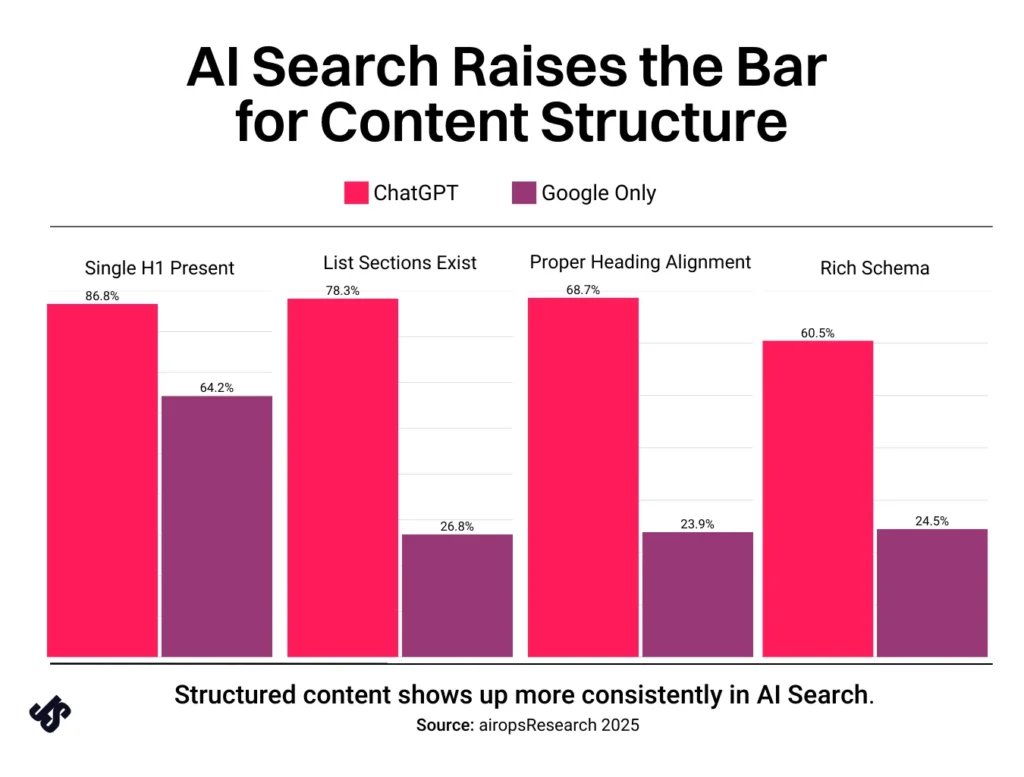
When content gets broken into parts and recombined, structure becomes essential. Structured content makes it easier for AI to extract.
- Clear headers and tags (H1, H2, H3, etc).
- Bullet points and lists.
- Definable answers to questions in sections that help AI systems understand your content and what it contributes to users.
- TL’DR summaries that help AI filter out the noise from long-form content and understand, index, and retrieve info more quickly.
This same structure also supports content repurposing. Well-organized pages are easier to adapt across AI summaries, sales content, email, and social, without losing clarity.
Content Refreshing and Repurposing Work Together
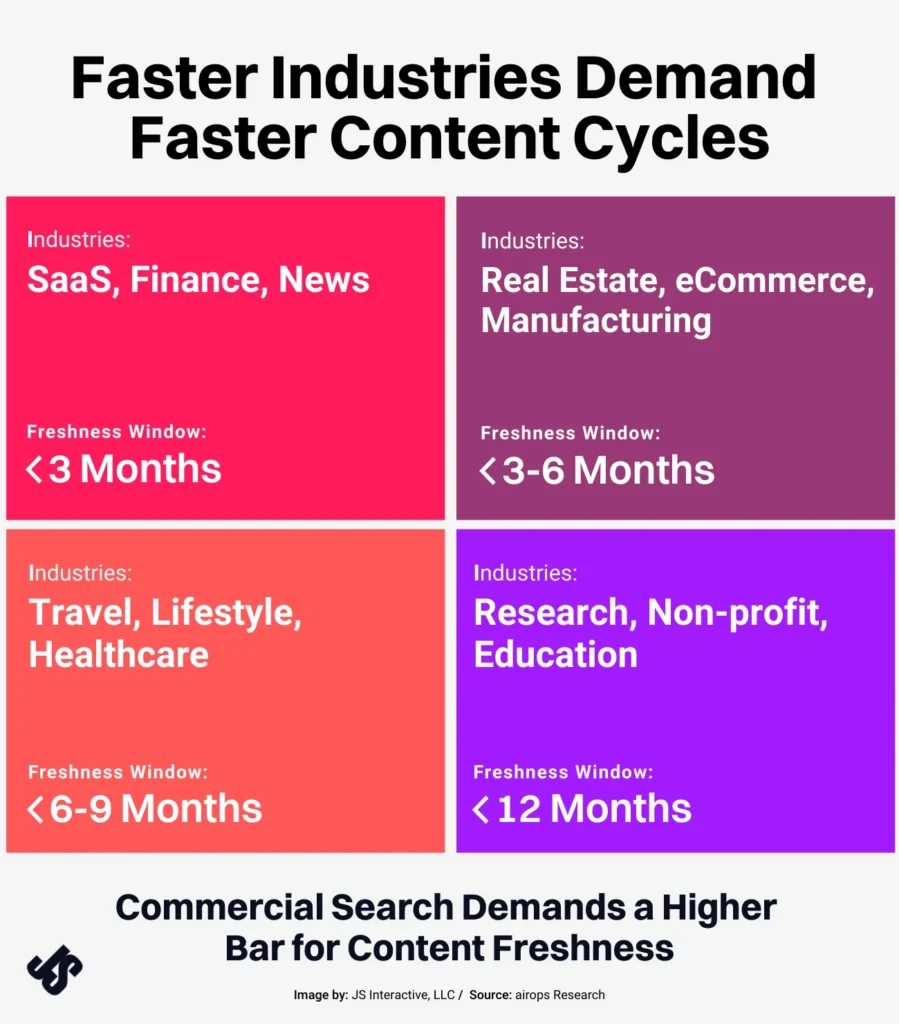
Query fan-out favors current, reliable information. AI systems prefer sources that reflect the present state of a topic, especially in commercial categories.
Content refreshing keeps strong pages accurate. Content repurposing extends the reach of that work by adapting updated insights into new formats.
In one case study, refreshing and republishing 20 older blog articles led to an 81% increase in organic clicks and a 106% increase in impressions over four months.
All of these points lead to the same conclusion.
Search now rewards content that stays useful over time, requires fewer assumptions, and involves more research, along with a clear plan for keeping strong pages accurate and current.
Improve AI SEO and Foundational SEO with JS Interactive
There is no separate AI SEO strategy.
Foundational SEO still determines whether content gets indexed, understood, and trusted. AI-driven search determines whether that content gets selected and cited when answers are generated.
The difference is execution.
Teams that are adapting are publishing fewer pages, structuring them more intentionally, and keeping strong content current. They are building resources that support multiple layers of intent and hold up when search systems compare sources side by side.
This is how we approach SEO at JS Interactive.
Not as a choice between foundational SEO and AI SEO, but as a single digital marketing strategy built around clarity, depth, and credibility, designed for how search now works.
If you have questions or would like to learn in greater depth, contact us today for a free consultation.

Share Article


