

Before You Scale Marketing, Answer These 12 Brand Foundation Questions

A week ago, I had a brief conversation with an experienced social media strategist here in Austin, and it stuck with me.
She knew what she was doing. She had insights, a clear strategy, strong ideas, and a good read on where her client could win.
Sadly, she hit a wall.
Not because of the platform. Not because of the content.
The business just wasn’t internally ready to go all-in on a social media strategy.
A stronger foundation was needed first, and a clearer process on which to build.
This is a challenge that oftentimes teams overlook. When things stall, the instinct is to push harder on marketing. Or blame the lack of return on investment entirely on the marketing.
Marketing doesn’t fix internal challenges and processes. It works with what’s already there.
When the brand foundation isn’t in place, efforts to market a brand efficiently feel disconnected.
Why Isn’t My Marketing Working?
Dumping money into marketing doesn’t guarantee results. Marketing platforms increase visibility, but they do not fix underlying issues such as:
- Unclear identity
- Weak messaging
- Sales challenges
- Unclear value proposition
- Poor website experience
If the foundation is not strong and clearly defined, marketing spend has to work harder. It can amplify ambiguity rather than drive results.
12 Questions That Define Your Brand Foundation
Before you invest in more marketing, your brand foundation needs to be clear.
Step back, and make sure who you are, who you serve, and how you communicate value are clearly defined.
Here are the essential questions every business should be able to answer before pursuing a marketing campaign:
1. Who Are You?
If your answer changes depending on the platform, the audience, or who is writing the content, it isn’t clear enough.
Oftentimes, when I ask businesses, ‘who they are’, there is a natural inclination to respond with ‘what they do’. However, this is not about what you do. It is about who you are at your core.
Your identity should reflect:
- Your character
- Your personality
- Your core values
- Your culture
- Why your work matters to you
This is also where your brand voice starts to take shape. This includes:
- The language you use
- How direct or formal are you
- How do you explain ideas
- How you approach conversations
The way you communicate should feel consistent and recognizable across platforms and in-person, grounded in a clear point of view.
Without that clarity, marketing becomes inconsistent. The tone shifts, the message changes, and it becomes harder for people to understand who you are and what you stand for.
2. What Is Your Brand Vision, Mission, and Impact?
This is where direction comes from.
Your vision defines where you are going. Your mission explains what you are building and why it matters. Your impact reflects the positive change your business is creating.
When these are unclear, it shows up quickly. Messaging feels inconsistent. Priorities shift. Teams make decisions without a shared standard.
An example of a clear brand vision, mission, and its impact may look like:
- Vision: To become the trusted partner B2B companies rely on when their website is not producing results
- Mission: Help businesses turn underperforming websites into clear, focused tools that generate consistent opportunities
- Impact: Giving teams confidence in how they present themselves so they can attract the right clients and make better decisions
Clear vision, mission, and values provide your business with a reference point. They help you stay focused and guide your communication.
3. What Is Your Purpose Statement?
Your purpose statement acts as your declaration.
It’s the essence of your brand, and it answers a simple question: why does your business exist in the first place? Why does it matter?
A strong purpose statement gives your business meaning beyond the service itself. It helps people understand what you are trying to change, improve, or contribute.
Recently, I worked with Next 18, a national nonprofit that uses golf to provide mental wellness resources to veterans and first responders.
I helped them define their purpose in a simple declaration statement:
“Next 18 stands for lasting healing and a new outlook on life.”
We didn’t use this space to describe services. It defines what they represent and the impact they’re working toward.
Without a clear purpose, messaging can feel transactional. With it, your brand has something people can connect to.
4. What Does Your Visual Identity Look Like?
Your visual identity defines how your business presents itself.
It includes how your brand looks across your website, marketing materials, and any place a customer interacts with you visually. Your visual identity encompasses elements such as color, typography, imagery, layout, and overall style.
When this is not clearly defined, it shows up quickly. Designs feel inconsistent. Content looks disconnected. The brand does not feel recognizable across touchpoints. And sometimes, trust can erode quickly.
A strong visual identity creates consistency. It makes your brand easier to recognize and reinforces the message you are trying to communicate.
When the visual side aligns with your messaging, it strengthens how your brand is perceived and understood.
5. What Do Customers Expect From You?
Customer expectations shape how your business is perceived.
Whether you define it or not, those expectations already exist. They come from past experiences, word of mouth, your website, your content, and your team’s communication.
When expectations are unclear or inconsistent, friction shows up quickly. Messaging may promise one thing, while the experience delivers something else.
A company might position itself as responsive and easy to work with, but take days to reply to basic inquiries. Trust breaks down fast when those signals do not align.
This is where your brand promise comes in.
It is your commitment to the experience that people can expect when they work with you.
When that promise is clear and consistently met, it builds trust. When it is not, even strong marketing struggles to perform.
6. What Makes You Different?
If you cannot clearly explain how you are different, your audience will default to comparing you on price, convenience, or surface-level features.
This is where brand differentiation comes into play.
Most businesses rely on the same language.
- Quality service
- Experienced team
- Customer-focused
These statements don’t create separation. They are expected.
What matters is defining a difference that is specific and easy to understand.
For example, instead of being a fitness provider or a gym, maybe you specialize in in-home strength training programs for adults over 50 recovering from injuries or dealing with mobility issues.
The difference may come from how you approach your work, the type of clients you focus on, the problems you solve, or how you deliver your services.
When the distinction is not clear, marketing blends in. When it is, it gives people a reason to choose you.
7. Who Are You Targeting?
Be clear about who you are trying to reach.
When the audience (or buyer) is not clearly defined, messaging becomes broad and less effective. It starts to sound generic because it is trying to appeal to too many people at once.
Clarity here allows you to speak directly to the needs, priorities, and context of a specific group. It makes your message easier to understand and more relevant.
A simple way to build an audience persona is to define:
- Who they are
- What they are responsible for
- What problems are they trying to solve
- What influences their decisions
- On what platforms do they consume information
Trying to reach everyone usually results in connecting with no one. Honing in on your audience makes room for highly personalized experiences online.
8. What Are Your Customers’ Pain Points?
Once your audience is defined, the next step is understanding what they are dealing with.
Pain points are the problems, frustrations, or obstacles that create a need for your service. Without a clear understanding of these, messaging can miss the mark.
These challenges show up in everyday ways. Someone may feel overwhelmed trying to make the right decision, be unsure who to trust, or be frustrated after wasting time and money on something that didn’t work. Others may feel stuck, under pressure to deliver results, or unsure what the next step should be.
The more clearly you understand what your customers are dealing with, the easier it becomes to communicate in a way that feels useful and relevant.
9. How Do You Solve Customer Problems?
Understanding the problem is only part of it. You need to clearly show how you address it.
This is where many businesses lose clarity. They describe services, features, or processes, but never connect them back to the actual problem.
Your audience is not looking for a list of what you offer. They are trying to understand how their situation improves by working with you.
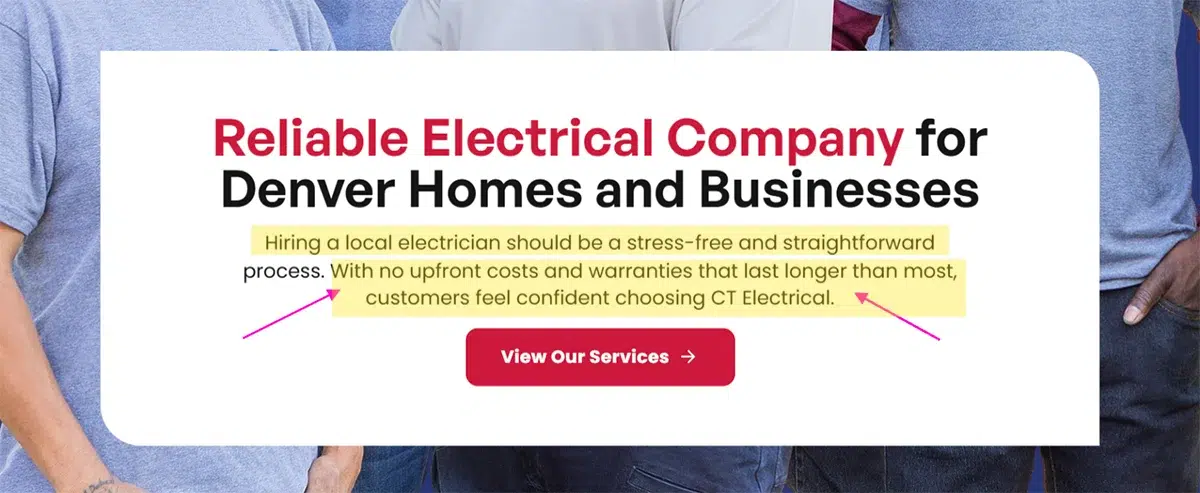
In the example above, rather than listing general electrical services, CT Electrical Services focuses on how those services create a more reliable, predictable experience. Clear timelines, upfront pricing, and long-lasting work help homeowners avoid stress, unexpected costs, and repeat issues.
When the connection between problem and solution is clear, your message becomes easier to understand and more effective.
10. What Key Services Do You Deliver?
It’s important to have clarity about what you offer.
When services are loosely defined or overly broad, it becomes harder for people to understand where you fit or how you can help. It can also create confusion in sales conversations and expectations.
Clarity is not about listing everything you can do. It is about defining the core services that align with the problems you solve.
For example, instead of presenting a long list of capabilities, Colorado Electrical Engineering focuses on the few services that directly support your positioning and make it easier for your audience to understand what working with you looks like.

In this instance, their consulting service is positioned as guidance through a complex process. Instead of focusing on technical details, it emphasizes clarity, coordination, and peace of mind. The value lies not just in the service itself, but in helping clients navigate what would otherwise feel overwhelming.
When your services are clearly defined, it becomes easier for people to connect your offering to their needs.
11. How Have Customers Benefited From Your Work?
Results build credibility.
At this point, you have defined who you are, who you serve, and how you help. The next step is showing that it works.
Without proof, messaging relies on claims. With proof, consumers are more likely to trust what you are saying.
Building brand reputation can take many forms:
- Testimonials that speak to the experience.
- Case examples that show before and after.
- Specific outcomes tied to the problems you solve.
The goal with trist signals is not volume. Its relevance. The more closely your examples reflect the challenges your audience faces, the more effective they become.
When results are clear and visible, they reinforce everything else in your brand foundation.
12. What Does Your Sales Process Look Like?
Many businesses focus heavily on generating leads but give less attention or critical thought to what happens next. To avoid lost opportunities, your process must be clear, consistent, and easy to follow.
Your sales process should outline the key steps from initial contact to close. This may include discovery, qualification, proposal, and follow-up. Each step should have a clear purpose and a consistent experience.
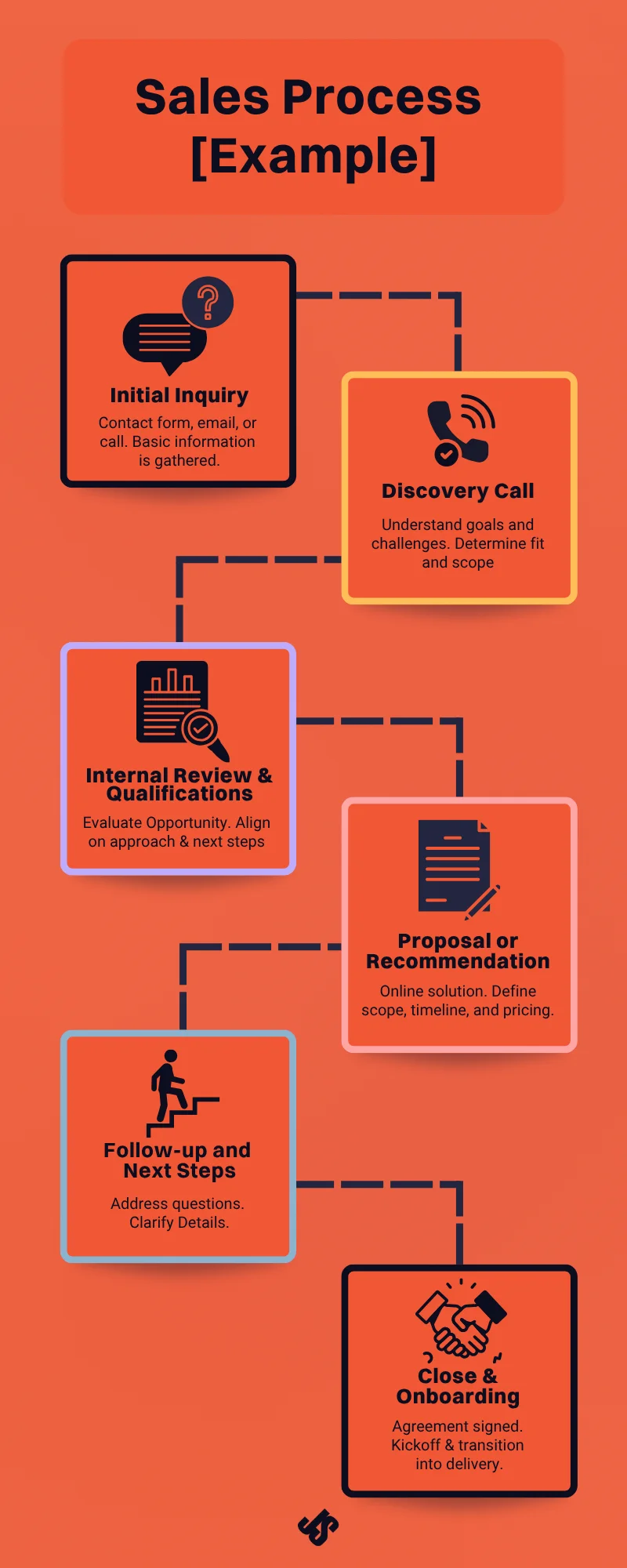
When a process is not defined, it creates gaps between marketing and sales. Leads come in, but conversion becomes unpredictable.
Let’s Build Your Brand Foundation Before You Start Scaling
Marketing amplifies what already exists.
If your brand foundation is unclear, more marketing will only make the gaps more visible.
When results feel inconsistent, it is often a sign that the fundamentals need attention.
If you are investing in marketing but not seeing the return, it may be time to step back and define your brand foundation. Contact JS Interactive today to get that foundation in place before you scale.

Share Article


