

10 Ways to Optimize Your Web Design in 2026

For years, teams judged web design by one primary outcome. Did it drive traffic?
This question no longer tells the full story.
Fewer users reach websites through traditional discovery. Search and AI interfaces now handle much of the initial comparison and context-building. Rankings can remain stable while sessions decline, which leaves many teams questioning whether a website still matters in 2026.
Well, it certainly does. However, what has changed is its role.
Websites no longer function as simple traffic engines. They support decisions and provide the foundation on which AI systems rely when explaining products, services, and brands.
Web design in 2026 is about building a credible source of truth that serves users, search engines, and AI systems simultaneously.
How New Are AI-Built Websites, Really?
AI-built websites may feel new. You enter a few prompts, and a finished site appears in minutes. It looks like a sharp break from how websites were built in the past.
But is it really?
Long before AI, teams launched fast, template-driven sites. A pre-built theme from a marketplace like ThemeForest serves as a starting point for tight timelines and budgets, allowing a website to go live with minimal customization.
These templates aren’t developed to be a final product. They are more like a first draft.
AI tools extend that same concept. It can create a visual design by suggesting layouts, generating imagery, and drafting copy in a single flow with a few prompts. What once required manual setup now arrives almost instantly.
This shift aligns with how teams already work. AI use across marketing and design is no longer about experimentation, but is now part of daily workflows.
WordPress continues to move in this direction, with AI agents that can spin up test environments, adjust code, and refine builds in short cycles.
Where AI Helps and Where It Hurts
AI performs well when speed matters. It’s easier to move from idea to prototype and to compare multiple approaches without heavy upfront effort.
When teams rely heavily on prompts and default patterns, they tend to produce similar outcomes with headlines, layouts, and positioning. Much like a cookie-cutter template, this can flatten brand identity and make it harder for any site to feel unique or memorable.
AI also lacks lived context. It doesn’t hear customer language from sales calls or understand what finally convinces a potential lead to act. Insights like these shape navigation, accessibility choices, content depth, and calls to action.
Automated builders cannot make these decisions reliably, often leaving pages feeling thin or misaligned with real intent.
Do Websites Still Matter in a Zero-Click World?
Users view AI panels long before visiting a website and are less likely to click links, even when those links appear in organic results.
This pattern is often described as the “60% problem” in AI search.
Roughly six out of ten searches now resolve without an external visit. Traffic loss alone no longer tells the full story of performance.
The role of websites has shifted.
Websites now carry the weight of validation. They are where prospects confirm pricing, compare options, review proof points, and decide whether to move forward.
When users click, they do so with intent. The website’s job is not to introduce the brand. It is to support a decision.
Local and branded searches reinforce this shift. These visits happen when users want confirmation. At this point, it’s where clarity, trust signals, and usability matter far more than volume.
This is where the model transitions from a traffic engine to a proof engine.
Traditional metrics underreport impact because they focus on clicks and sessions. They miss brand presence inside AI answers and non-click search features. In this environment, performance shows up in conversions, assisted conversions, and branded demand.
Cutting content or redesigning pages purely in response to traffic drops can backfire.
Lower sessions often reflect how search engines (like Google) surface information now, not whether a site failed to do its job by providing quality content.
Where Do Websites Fit in an AI-First Buying Journey?
By the time users reach a website, they are usually closer to a decision. Search and AI tools handle most early-education (top-of-funnel) and comparison tasks (middle-of-the-funnel), shifting the website’s role to validation.
It’s at this point in a user’s journey that the website needs to do three things well:
- Confirm fit: clearly show who the brand serves and what problem it solves
- Address objections: answer obvious questions that could slow a decision
- Guide next steps: clear path to conversion
Websites also influence how brands are understood beyond human visitors:
- AI source of truth: articles, FAQs, and documentation shape how AI systems describe topics and brands
- Content quality: clear structure, real expertise, and visible authorship carry more weight than generic pages
- Trust signals: consistent branding, named authors, recent updates, social proof, and structured data reinforce credibility and clarity
In an AI-first buying journey, the website doesn’t start the conversation. It gives a user confidence and moves decisions forward.
10 Ways to Optimize Your Web Design for Peak Performance in 2026
The following areas have the greatest impact on clarity, credibility, and conversion when an online user’s intent is high.
1. Build Authentic, Differentiated Branding
Clear positioning, consistent language, and intentional visual choices help users quickly understand who the brand serves and why it is different. Generic messaging and stock layouts signal uncertainty, even when the offering is strong.
Visible social proof reinforces those signals. Reviews, testimonials, certifications, and real examples reduce hesitation and support faster decisions, especially on pricing and service pages.
Effective branding in 2026 is about being recognizable, memorable, and believable in a buyer’s decision-making journey.
2. Clarify Your Messaging and UX for Deep‑Funnel Users
By the time users reach a website, they already have context. They are not browsing. They are checking whether the brand fits their needs and whether the next step feels worth taking.
This makes clear brand messaging essential. Pages should quickly communicate who the brand serves, what problem it solves, and why this option makes sense now. When messaging is vague, inconsistent, or buried, hesitation increases and momentum stalls.
UX should reinforce that message. Navigation, page hierarchy, and layout need to guide users toward high-intent actions without friction. Booking a consult, requesting a quote, or starting a demo should feel obvious, not hidden behind extra steps.
Strong brand messaging and UX work together. One sets expectations. The other confirms them and moves the decision forward.
3. Implement Clean Structured Data and Schema
Structured data helps search engines and AI systems understand what a site represents, not just what it says.
Schema should be part of the build, not an afterthought. When implemented correctly, it reduces ambiguity for both search engines and AI interfaces.
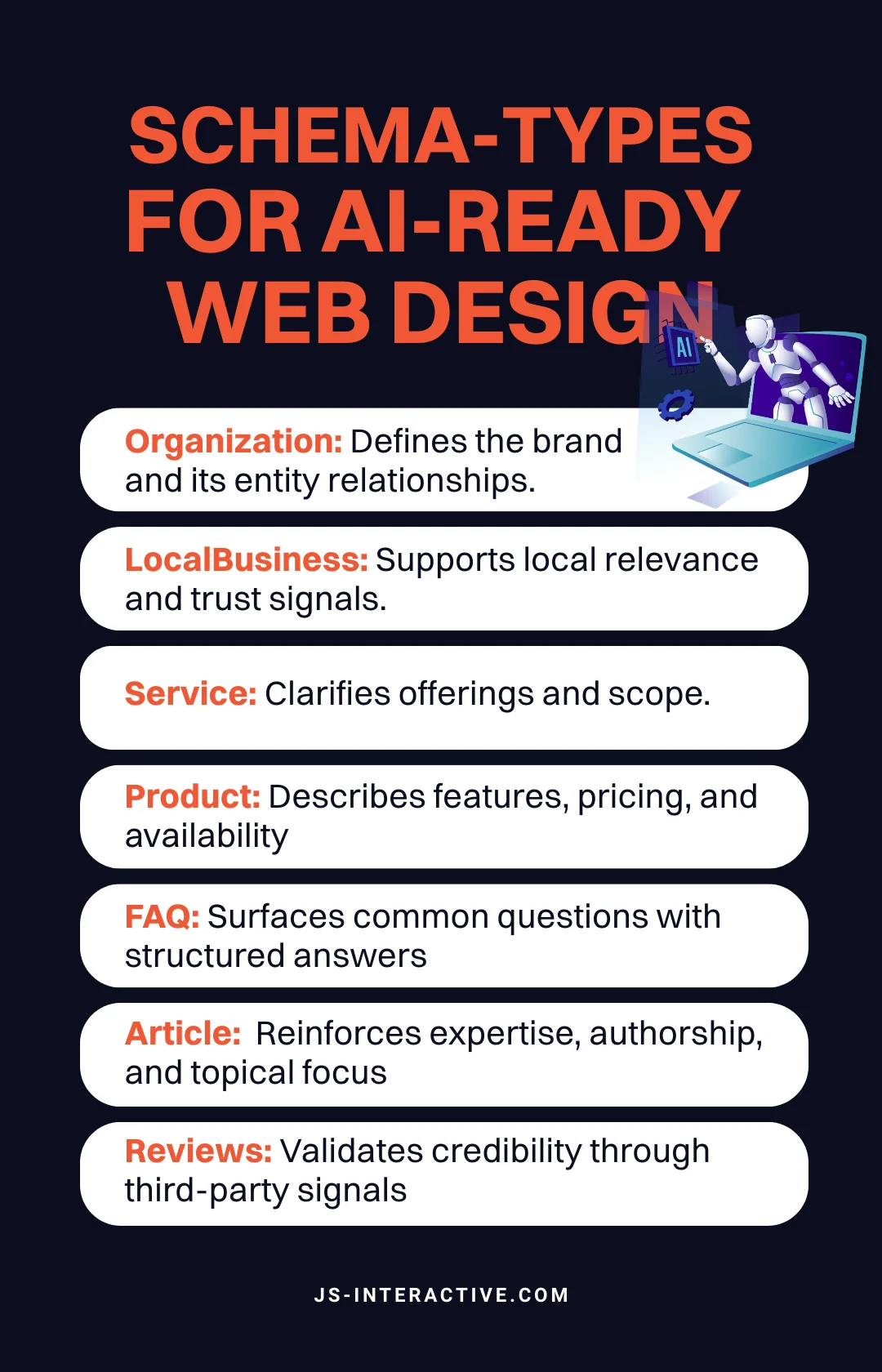
Key schema types to include where applicable:
- Organization to define the brand and its entity relationships
- LocalBusiness to support local relevance and trust signals
- Service to clarify offerings and scope
- Product to describe features, pricing, and availability
- FAQ to surface common questions with structured answers
- Article to reinforce expertise, authorship, and topical focus
- Review to validate credibility through third-party signals[1]
When applied consistently, structured data improves search visibility and makes AI interpretation more reliable. It doesn’t replace strong content or clear UX. It reinforces both by making intent and meaning easier to interpret.
4. Design for Accessibility and Clear Conversion Paths
Accessibility and conversion both reduce friction on a website when someone is deciding to act.
Pages should be easy to read, navigate, and use across multiple devices. Color contrast, readable typography, keyboard navigation, descriptive alt text, and clear focus states make content usable for more people and reduce unnecessary drop-off.
Conversion paths need the same level of clarity. Each high-intent page should support a primary action and make that action easy to find and complete in a few steps. Forms, buttons, and calls to action should feel intentional and predictable, not hidden or overwhelming.
When accessibility and conversion work together, fewer users get stuck. More users move forward with confidence.
5. Cultivate Brand Sentiment and Trust Signals
Brand sentiment forms before a user ever lands on a website, but the site is where that perception gets confirmed or corrected.
Reviews, testimonials, certifications, and third-party mentions should appear where they support specific claims. Social proof works best when it aligns directly with the service, product, or promise on the page, not when it lives in isolation.
Accuracy matters as much as visibility. Outdated reviews, stale credentials, or conflicting messaging erode confidence quietly and quickly. Teams often focus on adding new proof while overlooking the cost of leaving old signals in place.
Strong sites treat trust signals as living assets. They review them regularly, keep them up to date, and ensure they reinforce the same story the rest of the site tells.
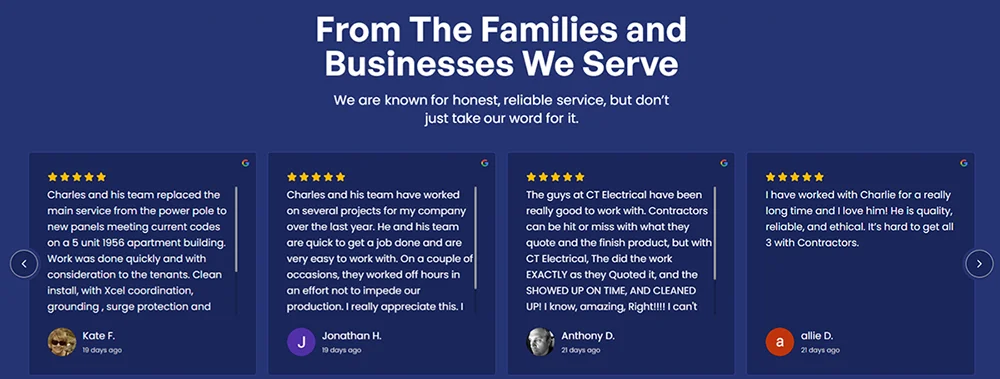
Image by: CT Electrical Services
6. Build an AI‑Optimized Content Hub
Isolated pages do not carry much weight on their own. What performs better is a connected body of content that clearly shows what a brand knows and how deeply it understands the problems it solves.
An effective content hub groups related pages around a core service or topic.
Guides, FAQs, case studies, and supporting articles should link to one another in a way that reflects how real questions expand from an initial search into a series of related information. This structure helps users move deeper and signals topical depth across related pages.
Original detail matters here. Content that includes real examples, specific processes, or first-hand insight provides clearer signals than generic explanations. This depth makes pages more useful to readers and more likely to be referenced or summarized accurately in AI-generated answers.
A strong content hub is not about volume. It is about coverage, connection, and clarity across the topics that matter most to the business.
7. Invest in Technical SEO and Core Web Vitals
Technical performance sets the floor for everything else. If a site is slow, unstable, or difficult to crawl, strong messaging and design cannot compensate.
Pages should load quickly, respond smoothly, and work reliably across devices. Core Web Vitals reflect real user experience signals that affect engagement and search visibility. Improving them reduces friction and supports consistent behavior, especially on high-intent pages.
Clean technical foundations also make content easier to access and interpret. Logical URL structures, simple navigation, and limited script bloat help search engines and AI systems crawl and understand the site without obstacles.
Technical SEO ensures nothing gets in the way of users or systems trying to reach and understand your site.
8. Use Descriptive Alt Text and Media Markup
Images and video only support performance when systems can interpret them correctly.
Alt text should explain what an image shows and how it relates to the page. This supports accessibility and gives systems the context they need to interpret visual content accurately. Missing or generic descriptions leave gaps that weaken understanding.
Media markup plays a similar role for richer assets. Video, image, and FAQ markup clarify what the content is, how it connects to the surrounding page, and when it should appear in search or AI-generated results.
When visuals and media are described with intent, they reinforce the page’s message rather than sitting alongside it.
9. Strengthen Security and Data Protection
Security is a baseline expectation. When a site feels unsafe or unstable, trust erodes immediately.
HTTPS, timely updates, and basic hardening protect both users and the site’s integrity. Lapses in security introduce warnings, outages, and performance issues that undermine confidence and disrupt engagement.
Security also affects consistency. Stable sites produce cleaner data, fewer interruptions, and more reliable access for both users and systems. This stability supports everything built on top of it, from conversions to visibility.
Strong sites treat security as maintenance, not a one-time project. They keep systems up to date, so nothing distracts from the decision the user is there to make.
10. Measure Performance with AI‑ and Zero‑Click‑Aware KPIs
When clicks no longer tell the full story, measurement has to change with them. This is where teams are redefining SEO KPIs to reflect how search actually influences decisions today.
Sessions and rankings still matter, but they cannot be the primary signal. Performance shows up in what happens after exposure, not just after a visit. Conversion rate, assisted conversions, branded search demand, and lead quality offer a clearer view of whether the site is doing its job.
Visibility that never turns into a click still carries weight. Brand presence in AI-generated answers, summaries, and rich results shapes perception and choice even when it does not register as traffic.
Strong reporting connects design, content, and visibility to outcomes. It moves beyond raw visits and shows how the website supports real business decisions.
How JS Interactive Helps Brands Win in 2026
JS Interactive builds sites that communicate clearly, drive high-intent actions, and perform well across search, AI interfaces, and modern buying journeys.
The focus stays on clarity, credibility, and results as search continues to evolve.
In need of a brand refresh or not sure where to start? Contact us today.

Share Article


