

Content Refresh: 5 Practical Steps to Keep Pages Relevant

Most content, once created, gets ignored.
Companies rely heavily on content to gain visibility and build brand authority. content for years. Their content calendar remains full as their library of information grows and their content topics stack.
Then performance slows.
Not because the ideas stopped mattering, or competitors suddenly became smarter. But because the strongest pages stopped evolving.
What was once relevant data gets outdated, and insights get buried. Content structure weakens, and slowly, there is a quiet decay.
When traffic stalls, the instinct is to publish more.
However, in most scenarios, publishing more only adds noise to pages that already need attention. The problem here isn’t production. It is neglect.
Even the strongest content drifts out of alignment over time. Buyer behavior changes. We’ve seen this significantly with AI Overivews part of a user’s journey.
Pages that once performed well can lose visibility without anyone noticing.
This is where content audits become a critical part of your marketing strategy.
Does Content Refreshing Improve Visibility?
In most cases, yes.
When strong pages fall out of alignment, for example, with old statistics and competitor refinements, visibility tends to follow. Not all at once, but gradually.
Search systems respond to this drift.
Updating existing content helps restore alignment.
- It signals relevance.
- It reflects current expectations.
- It clarifies intent.
In many situations, refreshing a proven page has a greater measurable impact than adding another post to the calendar.
But alignment alone is not enough.
Structure determines whether updated content gets understood, and it’s important to be human-centric while adapting to AI systems and how they, too, interpret content.
Humans want information fast. They scan before they commit. Their eyes seek out headings that closely match their question, short sections that respect their time, and clear takeaways they can trust.
AI systems interpret those same signals. They rely on hierarchy, placement, and context to determine what a page emphasizes and what it treats as secondary.
When content is current but poorly structured, it creates friction.
When content is current and clearly organized, it becomes easier to interpret, extract, and surface.
Refreshing keeps a page relevant. Structure makes that relevance visible.
5 Steps for a Smarter Content Refresh
Refreshing content is not a cosmetic exercise. It requires clear criteria and deliberate execution.
Here is a practical framework to guide the process.
Step 1: Identify Content Pages Worth Updating
Not every page deserves immediate attention.
Start with the assets that already carry weight. Focus on pages that have driven traffic, earned backlinks, or historically performed well but are beginning to decline.
Look for signals such as:
- Gradual drops in impressions or clicks
- Rankings slipping just outside the top positions
- Reduced engagement or conversions
- High-performing posts that have not been updated in over a year
These pages already have authority. They do not need to be replaced. They need refinement.
Prioritizing strong but aging content often yields faster results than building momentum from scratch.
Step 2: Update Your Content for Accuracy and Intent
Once you identify the right pages, focus on alignment.
Start with accuracy. Replace outdated statistics and remove references that no longer apply. Update screenshots, product details, and timelines where necessary.
Then look deeper.
Search intent evolves. The way people phrase questions changes. Competitors refine their answers to those questions.
Review the page through that lens:
- Does it still match what someone is trying to accomplish?
- Are key questions answered clearly and early?
- Has the problem definition shifted?
- Are there gaps that competitors now address better?
Refreshing content is about maintaining relevance; it’s not about adding more words
When a page reflects current expectations and clearly addresses the intent behind a query, it regains strength.
Step 3: Improve Content Structure
Structure determines what gets referred to by AI and Search Engines.
Research by Kevin Indig shows that 44.2% of AI citations come from the first 30% of a page. Another 31.1% come from the middle section, and 24.7% come from the final third.
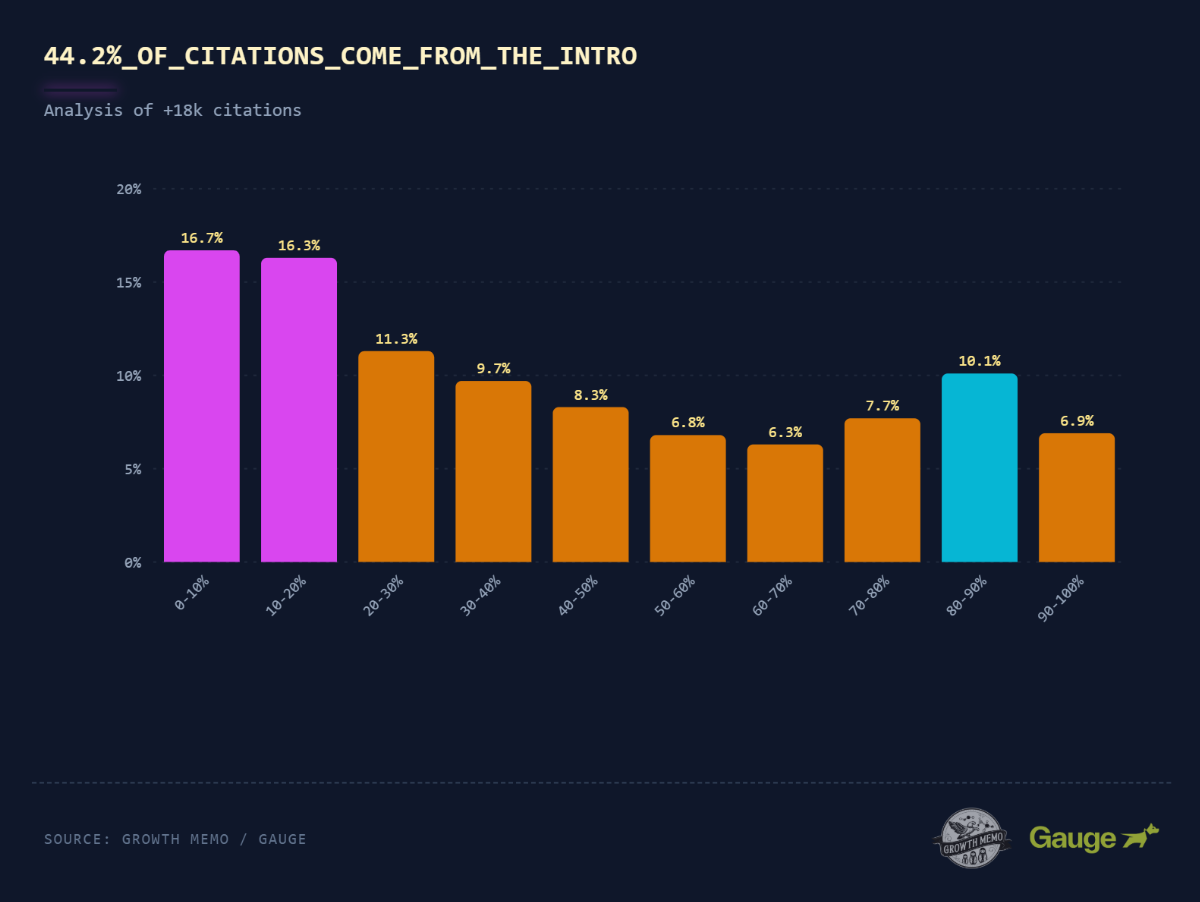
This distribution tells you something important.
Content positioned near the top is more likely to be referenced. When key insights appear late in a long article, they compete with diminishing attention.
This is not just about formatting. It is about hierarchy and emphasis.
To account for both readers and AI systems:
- Introduce your main takeaway early
- Place critical definitions and claims near the top
- Avoid hiding core value inside long, uninterrupted paragraphs
- Use descriptive subheadings to signal shifts in topic
- Include a concise recap before the footer
Strong placement makes strong ideas easier to extract.
When the most important points are clear and visible, both human readers and search systems can interpret the page with less friction.
Step 4: Strengthen Internal Links
Content rarely exists as a single answer.
When someone searches a topic, that query often expands into related follow-up questions. Overviews lead to comparisons, and definitions lead to deeper specifics.
Your content structure should reflect that expansion.
During a refresh, review how each updated page connects to related material:
- Link foundational content to deeper, supporting pages
- Ensure related subtopics have focused coverage where necessary
- Remove links that create overlap or confusion
- Use anchor text that clearly reflects the topic being linked
Internal links guide readers through a subject logically.
They also help search systems understand which page introduces a topic and which pages expand it.
When pages connect with intention, authority consolidates instead of scattering.
Step 5: Analyze Content Performance Before Creating More
A refresh should be measured before it is multiplied.
After updating content, give it space to respond. Monitor impressions, rankings, engagement, and conversions before adding new pages to the same topic.
Look for signals such as:
- Improved visibility for refreshed pages
- Increased time on page or interaction
- Stronger rankings for related queries
- Reduced overlap between competing pages
If refreshed content begins to regain traction, you have validation.
Only then should expansion enter the conversation.
Publishing new material before evaluating updates often creates redundancy. Publishing after measuring impact strengthens momentum.
Refresh first. Expand with intention.
Let JS Interactive Guide Your Content Strategy
Strong content libraries are not built through constant publishing. They are built through disciplined maintenance.
When pages stay current and clearly structured, visibility becomes more stable. Authority strengthens. Expansion becomes intentional instead of reactive.
Content refreshing is not a cleanup task. It is a credibility strategy.
At JS Interactive, we help brands identify where substance has drifted, where structure limits visibility, and where focused updates can restore momentum.
If performance has plateaued, a focused content review can uncover where refinement will make the difference.
Contact us today to schedule your consultation.

Share Article


