

Redefining SEO Success Metrics: 5 New KPIs for 2026

Every few months, the same conversation surfaces.
Throughout 2025, a pattern started to repeat across marketing conversations. It showed up on social media, in Reddit threads, and in how teams talked about performance internally.
SEO did not suddenly stop working, but the numbers started telling a different story. Traffic softened. Clicks declined. At the same time, demand often held steady. Leads continued. Brand searches increased. The signals no longer lined up cleanly.
That tension is becoming harder to ignore. Not because search is broken, but because the way people discover and evaluate brands has shifted faster than the way success is measured.
The Measurement Gap Created by AI Search
Search discovery no longer follows a straight line from query to click.
AI Overviews and chat tools now resolve approximately 60% of searches as zero-click experiences, particularly for informational and local queries. Users get explanations, comparisons, and recommendations directly in search without needing to visit a website.
This does not mean brands stopped influencing decisions. It means that influence often happens before analytics ever records a session.
Why Traditional SEO Metrics No Longer Tell the Full Story
SEO metrics were built for a version of search where evaluation happened on websites.
Today, clicks no longer reflect how people research or compare options. AI Overviews now capture more of that evaluation directly in the results page, transforming how users consume results even when rankings remain the same.
When AI Overviews appear, studies show organic click-through rates can drop by as much as 61%, despite stable positions. Visibility remains, but engagement shifts upstream.
Brand exposure increasingly replaces page-level interaction early in the journey. Users learn which brands exist, which ones feel credible, and which ones fit their needs before ever clicking.
Search behavior is also fragmented. People move between Google, AI tools, social platforms, reviews, and forums. Analytics platforms capture only the final interaction, not the discovery path that led there.
The result is an incomplete picture. Traditional metrics still show activity, but those “vanity” metrics no longer explain impact on their own.
Why Outdated Metrics Create Business Risk
When teams rely on incomplete metrics, decision-making starts to drift.
Traffic declines often get treated as proof that SEO performance is slipping, even when demand, leads, or revenue remain steady. That assumption pushes teams to react to surface-level signals rather than actual outcomes.
Content decisions suffer next. Pages that support awareness, comparison, or trust get cut because they no longer drive clicks, even though they still influence AI answers and buying decisions.
This creates a strategic risk, as budgeting and planning focus on easily measurable results rather than true growth drivers. As a result, teams allocate less budget to effective low-profile channels and invest more in strategies that look impressive on dashboards.
5 KPIs for Measuring SEO Success in 2026
If clicks and sessions no longer reflect SEO impact on users, success needs a different definition.
SEO still drives discovery, trust, and demand, but much of that impact now occurs before a website visit. Measuring success requires metrics that reflect visibility inside AI answers, brand recognition across fragmented journeys, and outcomes that show up later in the funnel.
Rankings, traffic, and conversions still matter; they just cannot stand alone.
The metrics that matter most going forward focus less on volume and more on influence. They show whether a brand appears where decisions are made, how it is positioned when it does, and whether that exposure translates into real business outcomes.
The following KPIs reflect how search works today and where SEO creates value in an AI-driven environment.
1. AI Visibility
AI Visibility measures whether your brand appears in AI-generated answers to queries that shape early discovery.
Unlike traditional SEO metrics, this is not about clicks or sessions. It is about presence at the moment AI systems summarize options, explain categories, or recommend solutions. If your brand does not appear there, discovery still happens, but it happens without you.
To evaluate AI visibility, SEO teams create a consistent set of high-value category, comparison, and problem-based queries, assessing how they are addressed across AI platforms like Perplexity or ChatGPT, and conversational tools. The goal is to understand:
- Whether your brand appears for the topics you want to own
- How often your brand appears compared with key competitors (its Share of Voice inside AI-generated results)
- How it is described when it does appear
This is where AI and foundational SEO come together in practice. The same work that improves rankings (clear topical focus, strong content, trustworthy entities, and technical health) also shapes how AI systems learn your brand, decide when to include it, and how confidently to recommend it.
Platforms such as SEMRush One and Usermaven now help support this process by tracking brand mentions and visibility across AI answers over time.
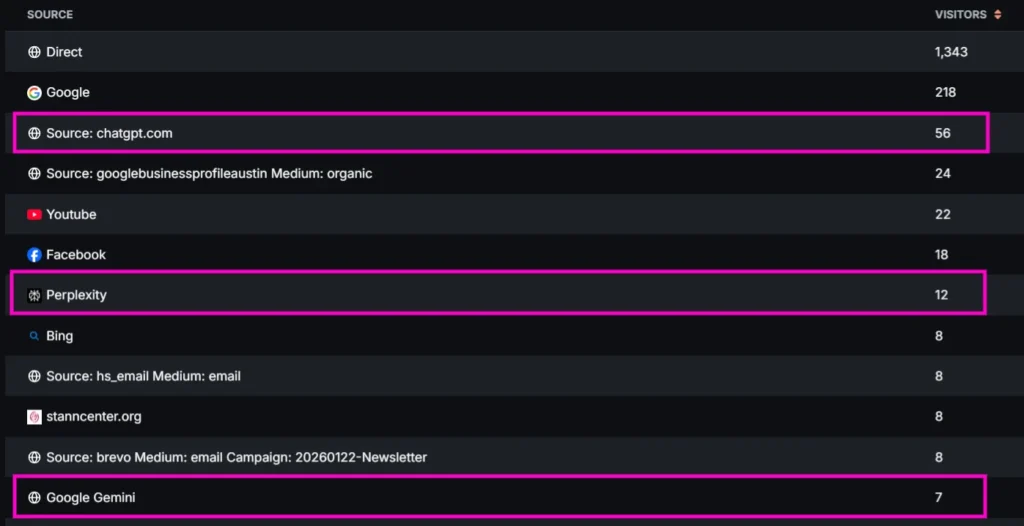
2. Dense Entity Relationships in SEO
AI systems treat brands as data entities. They analyze patterns, relevance, use cases, competitors, personal experiences, and problems solved, all of which form the context AI uses to decide when a brand should appear.
In SEO, Dense Entity Relationships measure how consistently and strongly AI systems connect your brand to relatable, authoritative signals in search engines.
For example, a company that sells enterprise project management software may frequently appear in AI responses.
However, if those appearances are limited to queries like “simple task tracking tools” or “budget project management software,” the AI system recognizes the brand but does not fully understand its position. The relationships exist, but they are shallow or incomplete.
When dense entity relationships are present, the pattern looks different. The brand may appear in queries like:
- Core Entity: Your Brand Name
- Related Entities: “Project management software”, “time tracking”, “task management software”, “Your Brand vs. Basecamp”, “simple task tracking tools’.
- The ’Dense’ Connection: Structured data (Schema) that connects the website to Google Business Profile, Facebook, Capterra, etc.
- The Results: Search engines see a high density of signals across multiple applications, making it easier to rank for ‘best project management software’.
Your brand is consistently connected to contextual use cases and compared against the competitors. Visibility aligns with intent, and discovery leads to better-fit demand.
3. Branded Search Lift (BSL) in SEO
Branded Search Lift measures whether visibility in AI answers turns into real demand over time.
As AI handles more early-stage discovery, users often do not click right away. Instead, they remember the brand and return later through branded searches, direct visits, or saved results.
This behavior does not show up as immediate SEO traffic, but it is one of the clearest signals that brand visibility is working.
For example, after a brand begins appearing consistently in AI responses for category-level queries, Search Console often shows growth in branded impressions weeks later.
When this metric is strong, it explains why traffic can look softer while pipeline and revenue remain steady. When Branded Search Lift is absent, brands may still appear in AI answers, but that exposure remains informational rather than memorable.
Consistent AI visibility naturally builds this delayed demand signal. Strong topical authority and entity clarity from your SEO work make brands more memorable when AI surfaces them alongside options.
4. Deep Funnel Quality
Deep Funnel Quality in SEO shows how well your website turns a high‑intent, middle-to-bottom-of-funnel audience from search into real leads and sales. This journey occurs after AI has handled most of the user’s early research.
Early research is often answered by AI tools, where fewer people click through to websites. However, for those who do visit your website, oftentimes they are much further along in their decision-making.
They have moved past top‑of‑funnel exploration and arrive with a specific problem, solution, or provider in mind, so sessions may decline while intent and purchase readiness rise.
One of the clearest signals of Deep Funnel Quality is Conversational Engagement Rate (CER). It shows how often high‑intent search visitors take meaningful actions once they arrive, such as:
- Starting a live chat from a key page (homepage or product page)
- Moving from a product page to a pricing page
- Filling out a “contact sales” or “talk to an expert” form
- Booking a meeting
In other words, CER reveals whether deep‑funnel traffic is merely browsing or actively moving toward becoming a customer.
Teams frequently see fewer organic sessions but a higher CER, better lead quality, and more revenue per visit, because AI has already filtered out casual researchers and sent you visitors who are close to making a decision.
In simple terms, Deep Funnel Quality tells you whether the people who still make it to your site from search are the right people, and whether your pages are doing a good job turning them into customers
5. Brand Sentiment and Trust
Brand sentiment and trust look beyond simple mentions. They measure how your brand is talked about and the tone that surrounds it. Reviews, social conversations, and online discussions all shape the signals that AI systems use to interpret your brand.
AI-generated answers describe, qualify, and compare brands using language that signals reliability, risk, or fit. These descriptions come from patterns in the content that AI can see, such as customer reviews, ratings, third-party articles, and conversations on platforms like Reddit.
This KPI assesses whether your brand is positioned as a safe choice, a situational option, or an alternative. Words like “reliable” or “trusted” carry more weight than simple inclusion.
For example, when testing the same query across AI tools, two brands may both appear. One is described as “most reliable,” while the other is framed as “lower-cost.” Both are visible, but the underlying sentiment is different, and that difference shapes how users feel about each option.
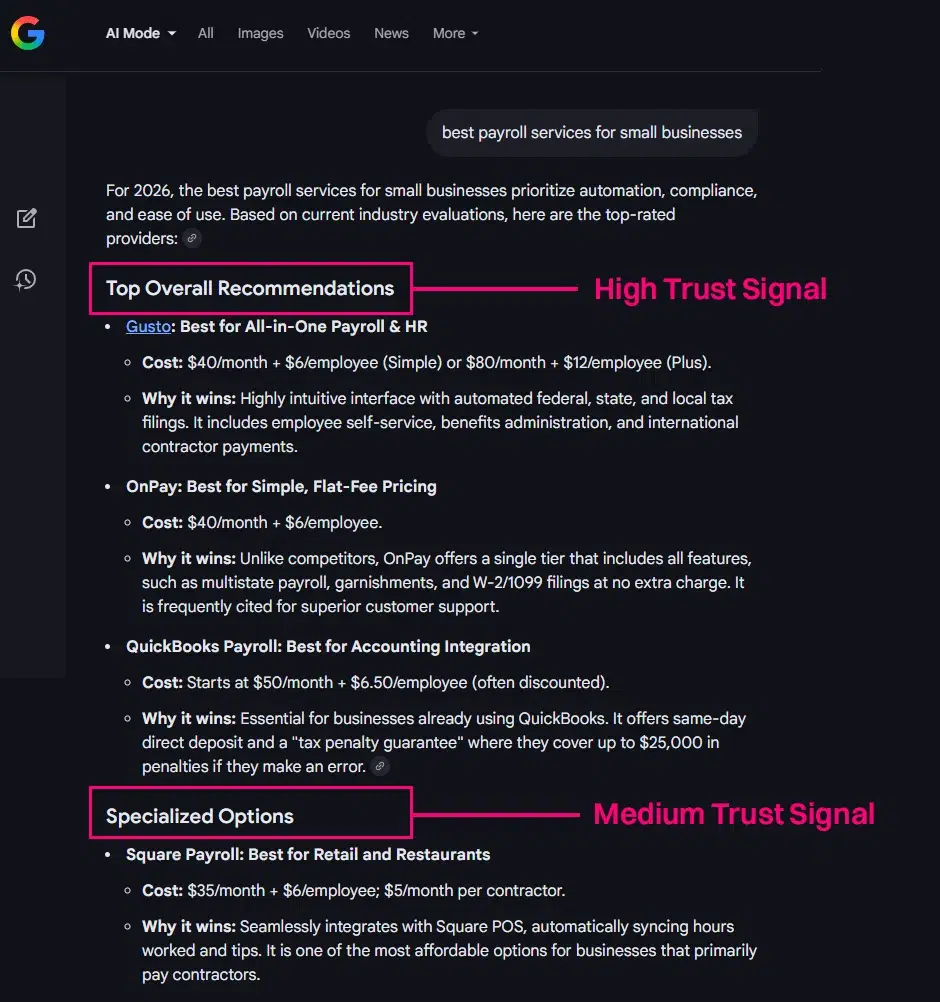
Sentiment matters because users trust AI judgments. Research shows tools like ChatGPT are seen as competent sources. When AI frames your brand confidently, that trust transfers.
SEO work that builds genuine authority through consistent messaging and expert content helps earn those favorable AI framings.
Measuring SEO Success with JS Interactive
AI search changed where discovery, comparison, and trust are formed. Clicks and sessions still matter, but visibility, alignment, and perception now shape demand long before analytics records a visit.
If your reports indicate declining traffic while demand remains steady, the issue may not be performance; it could be how you are measuring success.
At JS Interactive, we account for these shifts when evaluating SEO performance, focusing on visibility, trust, and outcomes rather than traffic alone.
Contact our team today for help rethinking how SEO success is measured.

Share Article


